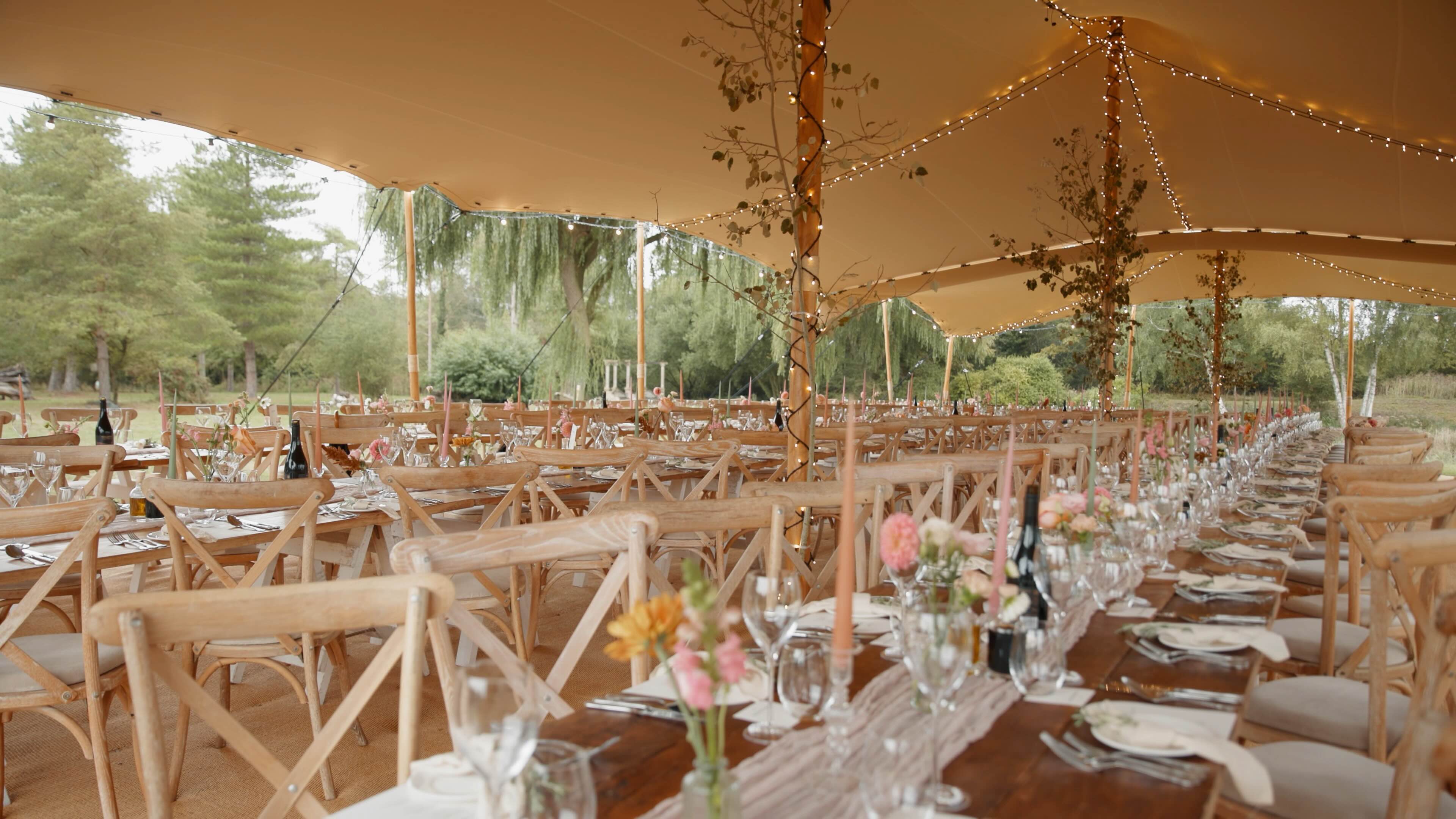
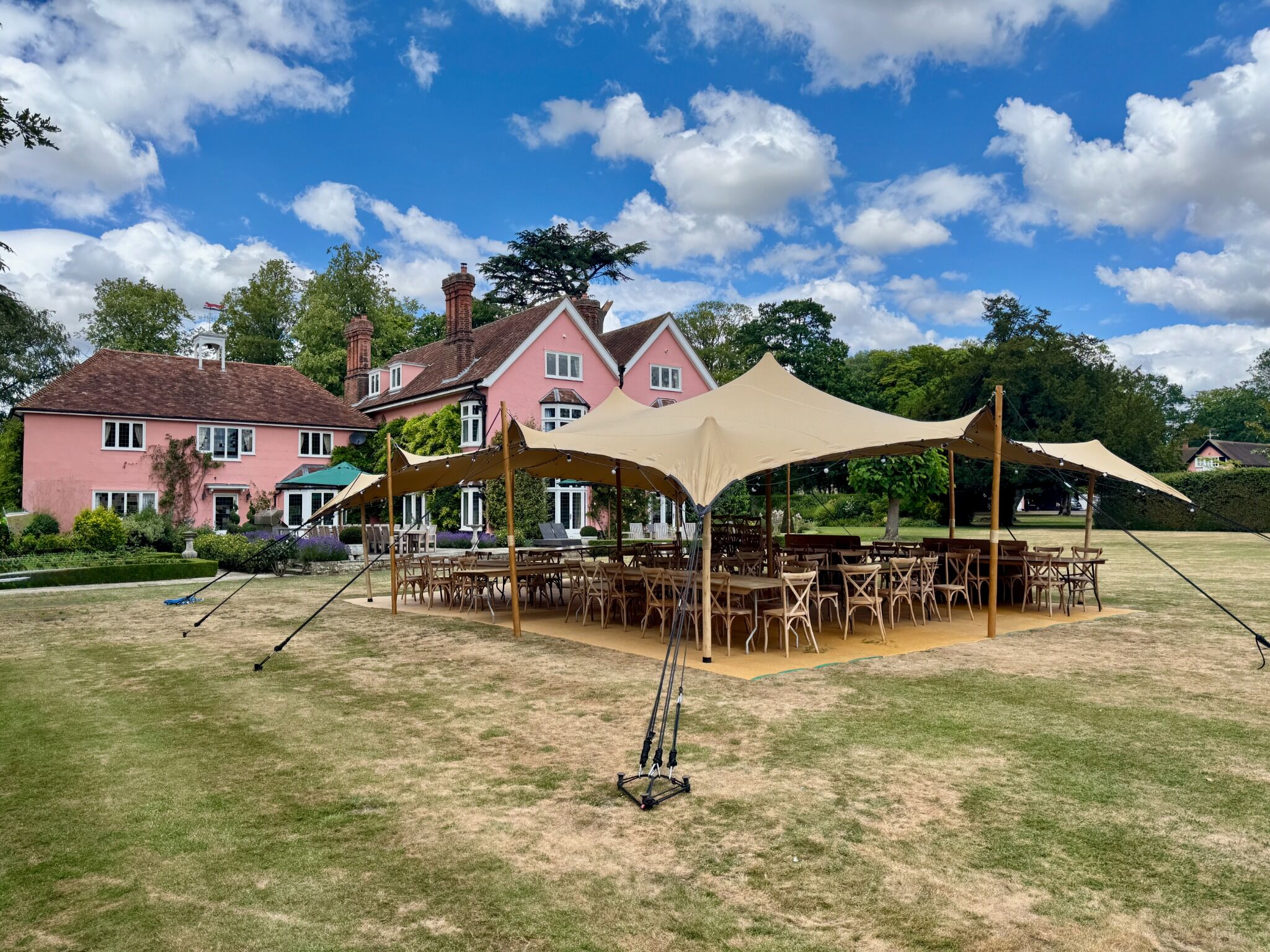
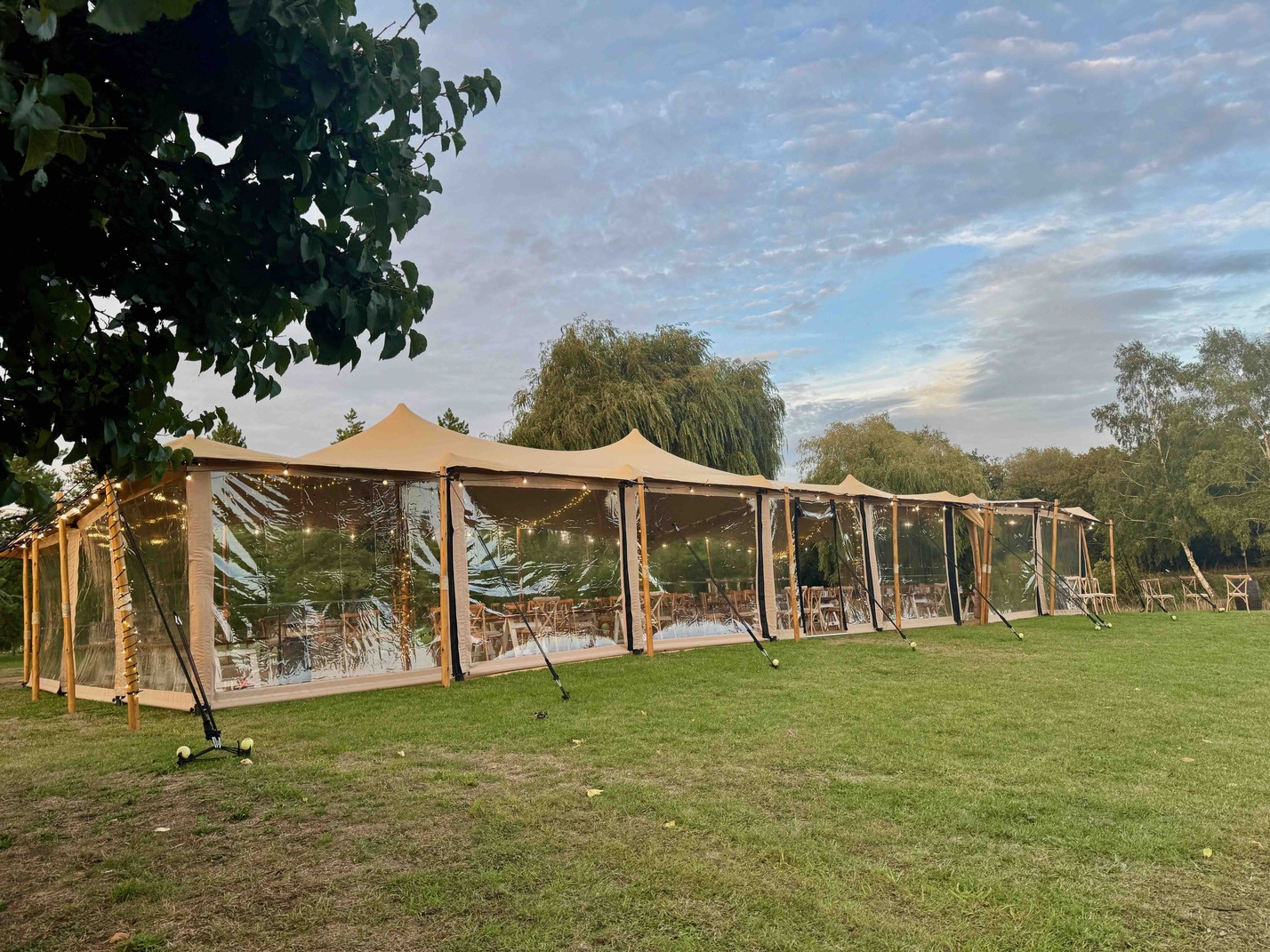
One of the most common questions we receive at Tent King is whether a stretch tent will fit in a particular garden or outdoor space.
While stretch tents are incredibly versatile, there's more to consider than simply measuring the area you want to cover. The available ground, surrounding buildings, trees and anchoring options all influence what can be installed.
The advantage of a stretch tent is that its configuration can be planned around the requirements of a particular location. We've worked in everything from open fields and private gardens to more confined courtyards, using different installation methods depending on the site.
However, not every space is suitable, and it's important to establish what's practical before deciding on a tent.
How much space does a stretch tent need?
The first thing to understand is that the dimensions of a stretch tent refer to the canopy itself, not the total area needed for installation.
A 10×15m stretch tent, for example, provides a canopy measuring approximately 150m², but the installation will generally require additional space around its perimeter.
This is because stretch tents are tensioned using guy ropes and anchors, which extend beyond the edges of the canopy.
The additional space required depends on the tent size, pole configuration and anchoring arrangements.
As an indication, one of our 6×10m stretch tent configurations may require an overall area of approximately 9×13m. However, this isn't a universal minimum, and the final requirements will depend on the installation.
If your garden is close to these dimensions, it doesn't necessarily mean a stretch tent is unsuitable. There may be alternative configurations worth considering, but these need to be assessed individually.
It's also important to consider what you want beneath the tent. A space suitable for a standing reception may not comfortably accommodate the same number of guests seated around dining tables, particularly if you're also planning a bar, dancefloor or other furniture.
Can a stretch tent fit in an awkward-shaped garden?
One of the main advantages of stretch tents is that their canopy shape can be adapted during installation.
Unlike a conventional framed structure, a stretch tent doesn't have to follow a completely uniform roofline. Different pole heights and configurations can be used to accommodate the surrounding space, provided the structure remains properly supported and tensioned.
This can be particularly useful in gardens with mature trees, uneven boundaries or buildings close to the proposed installation area.
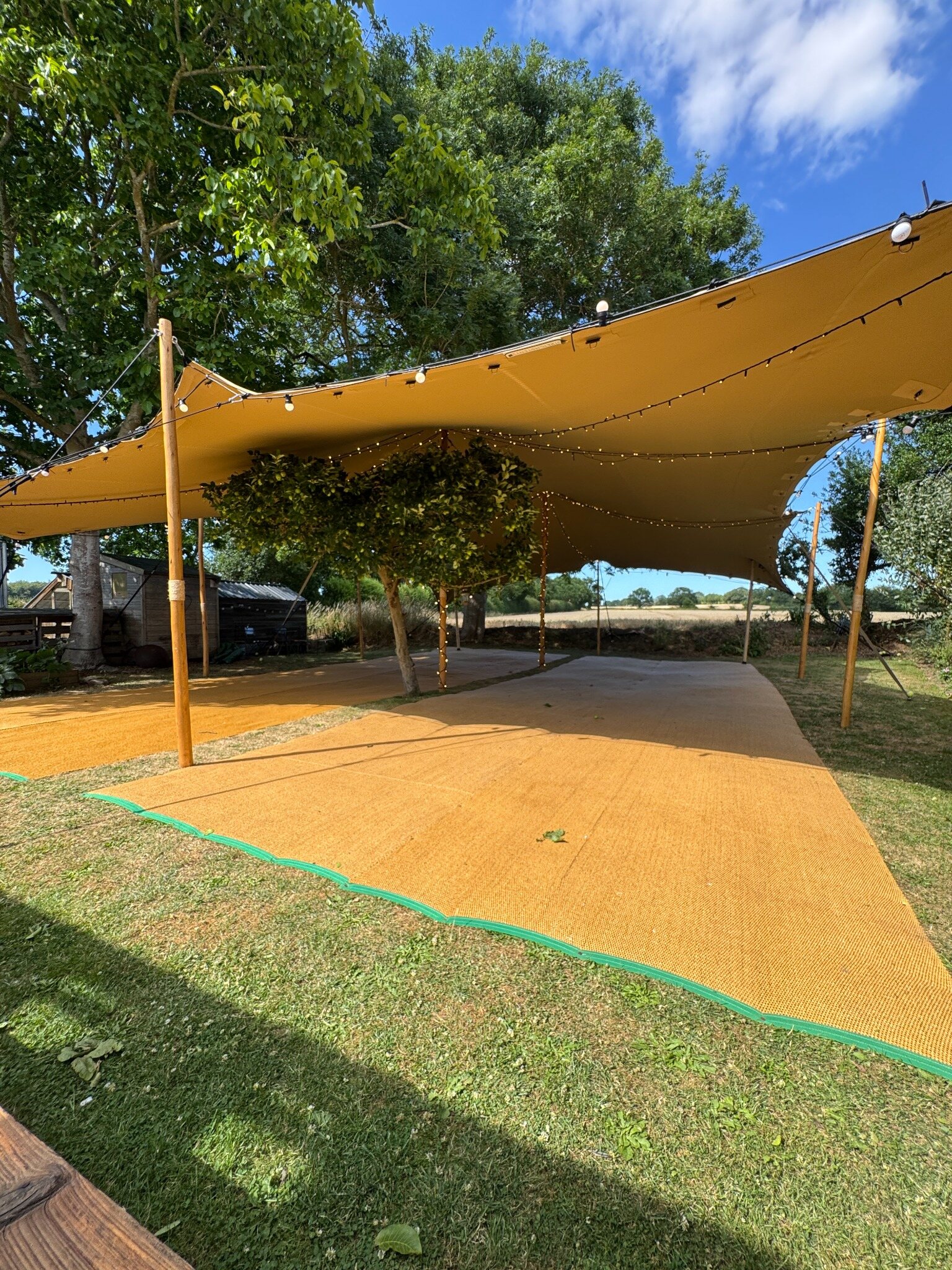
For example, we've installed stretch tents around existing trees, allowing them to remain part of the covered space rather than removing an important feature of the garden.
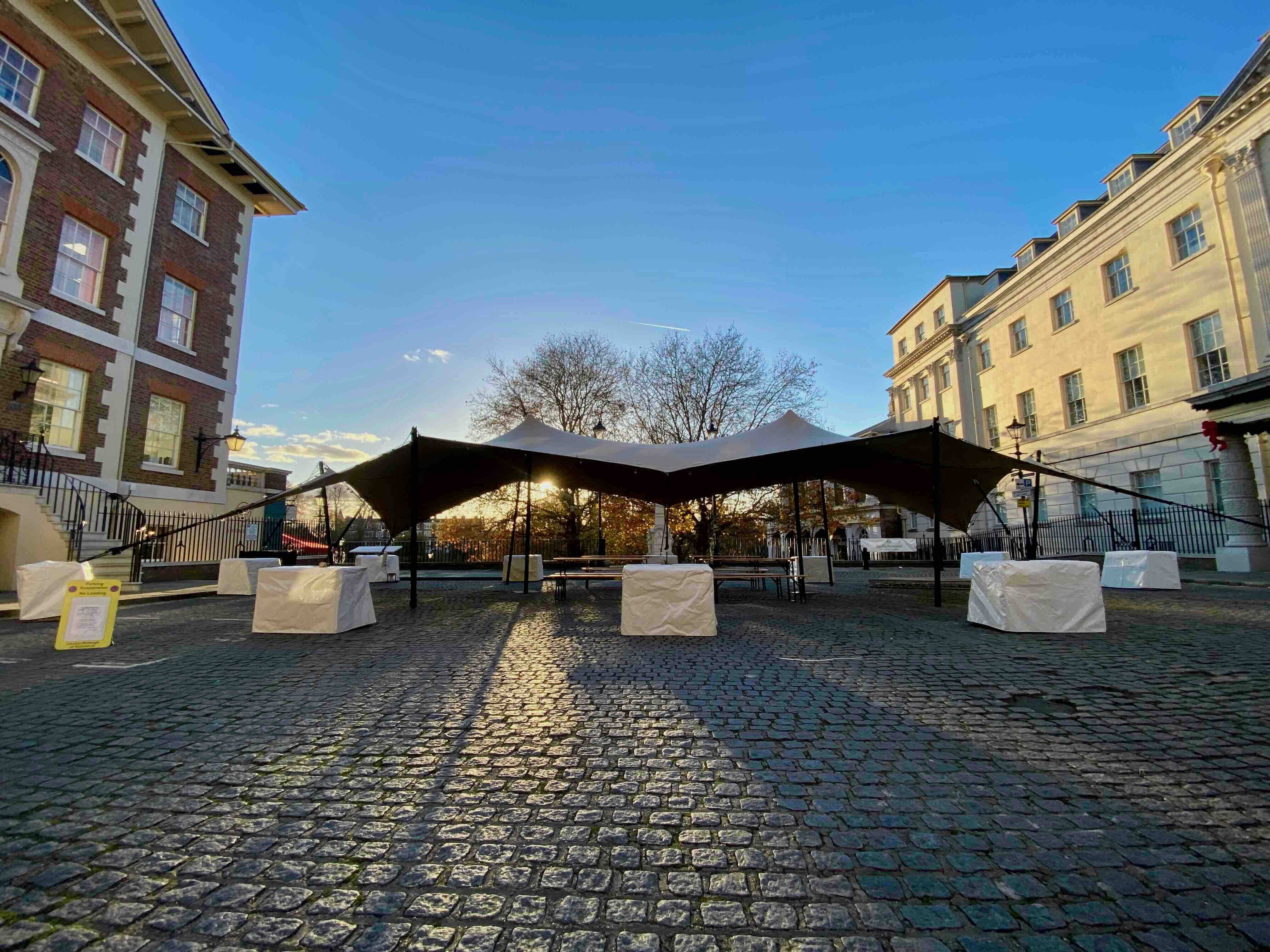
We've also worked in courtyards where the surrounding buildings limit the available space.
These installations require careful planning. The presence of a tree or building doesn't automatically mean it can be used to support or anchor a tent, but the surrounding features can sometimes be accommodated within a suitable design.
For anyone deciding between different types of event structures, our guide to stretch tents versus traditional marquees explains how the two compare in terms of flexibility, appearance and practical requirements.
What ground conditions are suitable?
Stretch tents are commonly installed on grass, where ground stakes can be used to anchor the structure.
However, the suitability of the ground depends on more than whether it's covered in grass. Soil conditions, moisture, underground obstacles and the loads the anchors need to resist all have to be considered.
Firm, suitable ground can provide an effective foundation for a properly designed installation. Very soft, waterlogged or otherwise unsuitable ground may require a different approach.
Hard surfaces, including paving, concrete and certain courtyard areas, present different challenges because conventional ground stakes may not be an option.
This doesn't necessarily rule out a stretch tent, but alternative anchoring arrangements must be assessed before confirming that the installation is feasible.
It's also important to establish whether underground services are present, particularly where ground stakes are proposed.
Water pipes, electrical cables, drainage and other buried infrastructure may restrict where anchors can safely be positioned.
Where necessary, we can work with the venue or property owner to establish the available information and agree an appropriate installation plan.
How are stretch tents anchored?
Secure anchoring is essential to every stretch tent installation.
The canopy is held under tension, and the anchoring system must be capable of resisting the loads generated by the structure, including those associated with wind.
Different sites may require different methods, and sometimes a combination of anchoring arrangements is appropriate.
Ground stakes
For many installations on suitable grass or soil, ground stakes are the preferred solution.
The stakes are driven into the ground at appropriate positions beyond the canopy perimeter, providing the anchoring points needed to tension the tent.
Their suitability depends on the ground conditions, the proposed loads and the specifications of the installation.
Structural fixing points
At some venues, an existing building or other structure may offer potential anchoring locations.
However, it's important not to assume that a wall, railing or other feature can safely withstand the forces from a tensioned canopy.
Any structural fixing needs to be appropriate for the supporting material and the loads involved.
We assess these possibilities individually and would only proceed where the proposed anchoring arrangement can be established as suitable.

Water ballast
Where ground stakes aren't suitable, water ballast may sometimes provide an alternative.
Water-filled tanks can be positioned at designated anchoring locations, with their suitability determined by the loads and requirements of the installation.
However, the capacity of a tank alone doesn't establish whether it provides adequate anchoring. The required ballast and the way it is secured must be appropriate for the particular structure and site.
Practical considerations also include whether sufficient water is available, how the tanks will be filled and emptied, and whether the ground can safely support the weight.
Concrete ballast
Concrete ballast can also be considered where other anchoring methods are unsuitable.
These blocks are generally brought to site using specialist lifting or handling equipment, so access and suitable ground conditions are important considerations.
As with water ballast, the weight and arrangement must be appropriate for the loads involved.
Concrete blocks aren't a universal solution, but they can be useful where a properly designed ballasted installation is feasible.
Can trees be used as anchor points?
Trees can sometimes provide suitable anchoring points, but this depends on their condition, size, structure and the loads they would be required to withstand.
Not every tree is suitable, and using an existing tree requires more consideration than simply attaching a rope around its trunk.
Where a tree is being considered as part of an anchoring arrangement, its suitability and the proposed method of attachment must be assessed.
It's also important to avoid unnecessary damage to the tree.
What about slopes and uneven ground?
A perfectly level lawn isn't always necessary for a stretch tent installation.
The heights and positions of the poles can sometimes be configured to accommodate changes in ground level while maintaining an appropriate canopy shape.
However, the slope must be suitable for the proposed installation, and the ground must still provide reliable support for the poles and anchoring system.
It's also worth considering how the ground will be used once the tent is installed.
An area that is suitable for the structure itself may not be comfortable for dining tables, chairs or a dancefloor without additional measures.
Where flooring or matting is required, we'll consider how it can be incorporated into the overall layout.
Access to the installation area
Another consideration that's sometimes overlooked is access.
Our installation team needs to be able to transport the tent, poles, anchoring equipment and any additional items to the proposed location.
For many garden installations, this is straightforward. However, narrow side passages, steps, restricted gateways and long distances from the unloading area can make the process more complicated.
Vehicle access is particularly important where heavy ballast or specialist equipment is required.
Restricted access doesn't necessarily prevent an installation, but it's something we need to understand before confirming the arrangements.
How exposed is your location?
The surrounding environment is another important consideration.
A sheltered garden surrounded by buildings and mature trees presents different conditions from an open field or coastal location exposed to prevailing winds.
The tent's configuration, anchoring requirements and suitability for the site must take these conditions into account.
Weather protection is also worth considering during the planning stages, particularly if you're arranging an event outside the height of summer.
We can discuss options such as transparent side panels, canopy configurations and the orientation of the tent to help provide appropriate shelter.
Our separate guide to how stretch tents perform in rain, wind and colder weather explains these considerations in more detail.
How can Tent King assess your space?
You don't need to know whether a stretch tent will fit before getting in touch.
If you have a particular garden or venue in mind, we can often make an initial assessment using photographs, approximate measurements and satellite imagery.
It helps to provide the location, the dimensions of the available space and photographs showing the surrounding buildings, trees and ground surface.
We'll also need to know the date of your event, approximate guest numbers and what you're planning to use the tent for.
From there, we can recommend suitable tent sizes and discuss any potential site constraints.
For more complicated installations, a site visit may be necessary to assess the available space and anchoring options in greater detail.
We can arrange this where appropriate and confirm any survey fee beforehand.
Planning an event in a challenging space?
At Tent King, we've installed stretch tents in a wide range of locations, from open countryside and private gardens to enclosed courtyards and sites with existing trees and buildings.
Every location is different, and our approach is to establish what can be installed safely while making the best use of the available space.
If you're unsure whether a stretch tent will fit your garden or venue, get in touch with Tent King with a few photographs and approximate measurements.
We can review your plans, advise on the available options and prepare an initial quotation where a suitable installation looks feasible.